
This week many of us took off our yellow ribbons and removed our hostage dog tags. The last of the captives, Sgt-Major Ran Gvili, of blessed memory, who fell defending his community (he fought to the last bullet, with a broken arm!) on October 7th, 2023, was located, and he finally came home. He was buried on Wednesday in his hometown of Meitar, and the entire country lined the streets to honor him.
It seems to many that not only was a ribbon or a dog tag removed, but a burden was lifted as well. All of the hostages, those alive and those who were murdered, are home, and for the first time in 14 years there are no captives in Gaza. A sacred responsibility of the state and the IDF has been fulfilled (and one of the stated war aims as well), going some distance to repair the failure and breach of promise of October 7th.
My friends, as we continue to help Israelis rebuild their homes, their families, and the shattered lives of the families of the fallen, symbols such as the dog tags and ribbons are as important as ever.
I challenge each of you to find your symbol of unity and solidarity. Your symbol of brotherhood and sisterhood. Your symbol of strength and resilience. Your symbol of loyalty to tradition and knowledge of who we are. For some, as is the case with thousands of IDF soldiers, reservists and others, it is wearing tzitzit, or laying tefillin - especially among those who live otherwise secular lives. For others, it is studying our most ancient texts - in the fields, in the rubble of Gaza, on hilltops and hi-rise rooftops - regardless of how one dresses or observes. It is a flag, an act of kindness, a reassuring look. It is an assertion of identity by these, and also by speaking up against the hatred that darkens our streets.
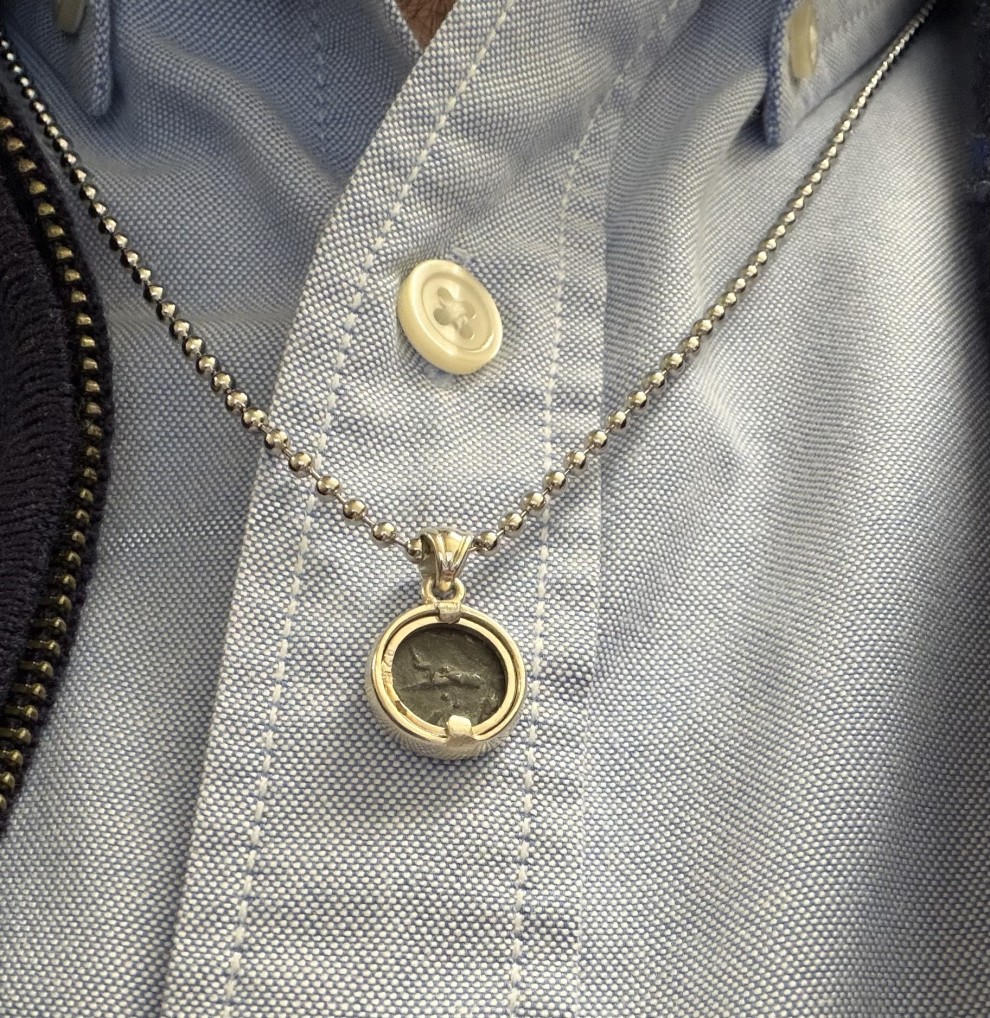
As for me, when I traveled to Israel in November, I knew what my symbol would be. I stopped in a small shop in the Cardo market, along the ancient road in Jerusalem’s old city. I bought a small coin, a bronze prutah, set in a silver pendant.
The coin that I now wear, hung on the same chain that held my dog tag, was minted 2,150 years ago, during the reign of the Hasmonean King Alexander Yannai. It was minted in a sovereign Jewish state, in the Jewish homeland, by Jews who prayed in the same language, observed the same holidays, studied the same texts, and carried the same Abrahamic values that we do. It is as strong a symbol of Jewish peoplehood, Jewish sovereignty, and Jewish resilience as I could find anywhere in the world.
This symbol crushes the lies of settler colonialism, it destroys the narrative of foreign interlopers, and it negates the insistence on Jewish impermanence in our homeland that has animated Palestinian nationalism for over a century. But more importantly, it heralds an unbroken tradition. A prutah was the value of currency upon which a contract could be agreed. It was the amount necessary to make a kinyan, an acquisition, the minimum, according to our Talmud, used to solemnize marriage, inheritance, or the giving of certain tithes as ritual obligation.
This symbol upends the supercessionism often demonstrated against us in forms of Christianity, Islam, and socialism, rendering our identity in our own terms as a People with a common religious practice PRECEDING any of these ideologies.
This week the international community observed its Holocaust Remembrance Day, a day which I approach with ambivalence at best. It isn’t our day to memorialize the six million, which is Yom Hashoah as a people or Tisha B’Av as a religious observance. No, not ours. Maybe one day the world will actually learn the lessons of the Holocaust, but I’m not holding my breath. There’s only one thing they may have learned, one thing our strength and resilience may have begun to teach them. As the words of Glick’s ‘Partisan Song’ say so clearly, MIR ZEYNEN DU! “We are still here!”
Over 2000 years later, we are still here.
Am Hanetzach Lo Mefached MiDerech Arucha. The eternal people do not fear the long road. We carry our symbols -wherever we go- over our hearts and within them.
We are still here.